
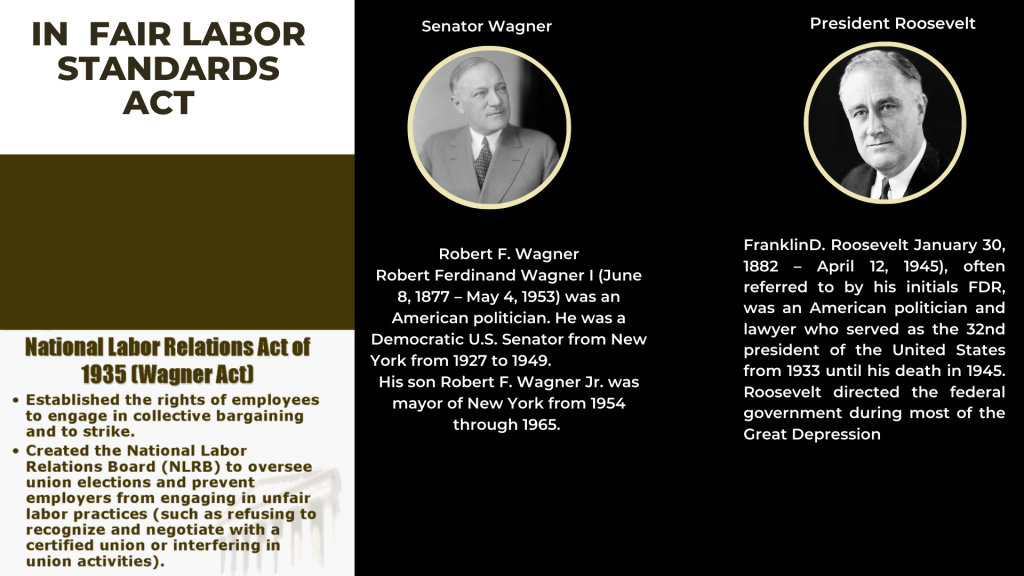
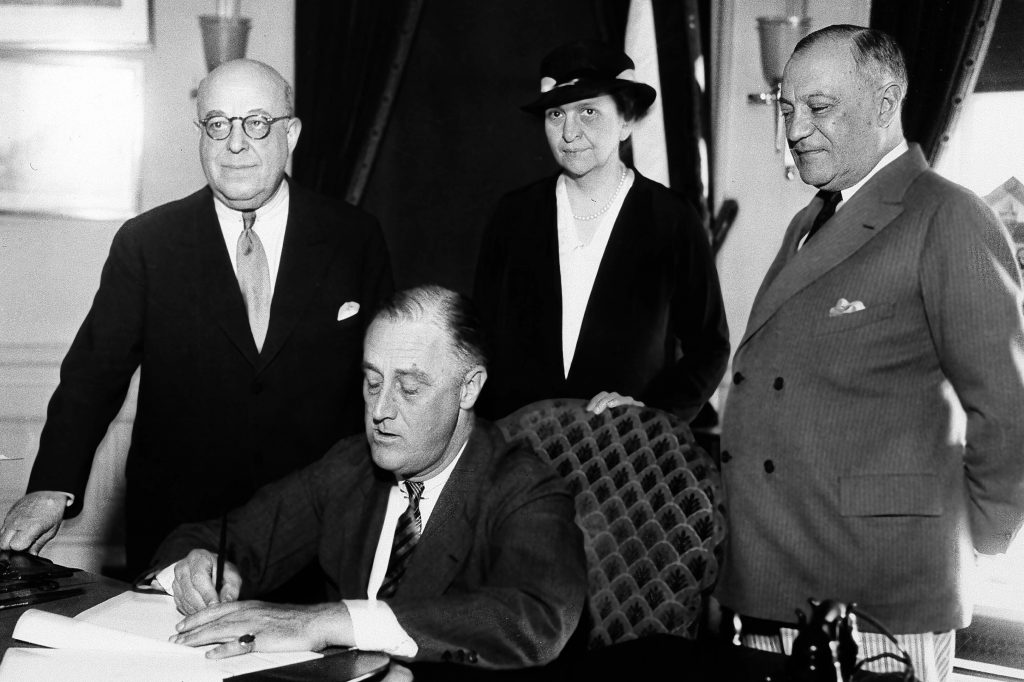
In the fall of 1934, Senator Wagner began revising his labor disputes bill, determined to build on the experience of the two earlier NIRA boards and to find a solution to the enforcement problem that had plagued them. In February 1935, Wagner introduced the National Labor Relations Act in the Senate. The Wagner Bill proposed to create a new independent agency—the National Labor Relations Board, made up of three members appointed by the President and confirmed by the Senate-to enforce employee rights rather than to mediate disputes. It gave employees the right, under Section 7, to form and join unions, and it obligated employers to bargain collectively with unions selected by a majority of the employees in an appropriate bargaining unit. Wagner’s Bill passed the Senate in May 1935, cleared the House in June, and was signed into law
President Roosevelt on July 5, 1935. A new national labor policy was born.
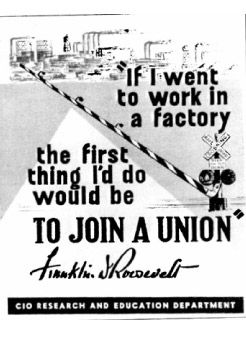
The Wagner Act protected workers’ rights to organize and created a vehicle through which labor disputes could be discussed and worked out. Though the provisions of the Wagner Act were diminished in 1947, it remains one of the most significant labor laws in U.S. history.
President Franklin D. Roosevelt signed into law the Fair Labor Standards Act also known as the Wagner Act, this bill was signed on July 5, 1935, a Friday.
It established the National Labor Relations Board and addressed relations between unions and employers in the private sector. as part of the New Deal, a series of programs designed to help move the US out of the Great Depression. The act formally codified the 44-hour workweek (and two years later, the limit was adjusted to 40). Any work done beyond that threshold meant employers would have to pay their workers overtime.
It took a few more attempts to get a broader law, but in January 1938 the bill that became the FLSA was sent to Congress. After the bill was debated and voted on, it was signed by President Roosevelt and became effective on October 24, 1938.
Robert F. Wagner of New York signed on June 14, 1938, effective October 24. The law, applying to all industries engaged in interstate commerce, established a minimum wage of 25 cents per hour for the first year, to be increased to 40 cents within seven years.
Exempt employees are employees who, based on the duties performed and the manner of compensation, are exempt from the FLSA minimum wage and overtime provisions. Exempt employees are paid an established monthly or annual salary and are expected to fulfill the duties of their positions regardless of the hours worked.