
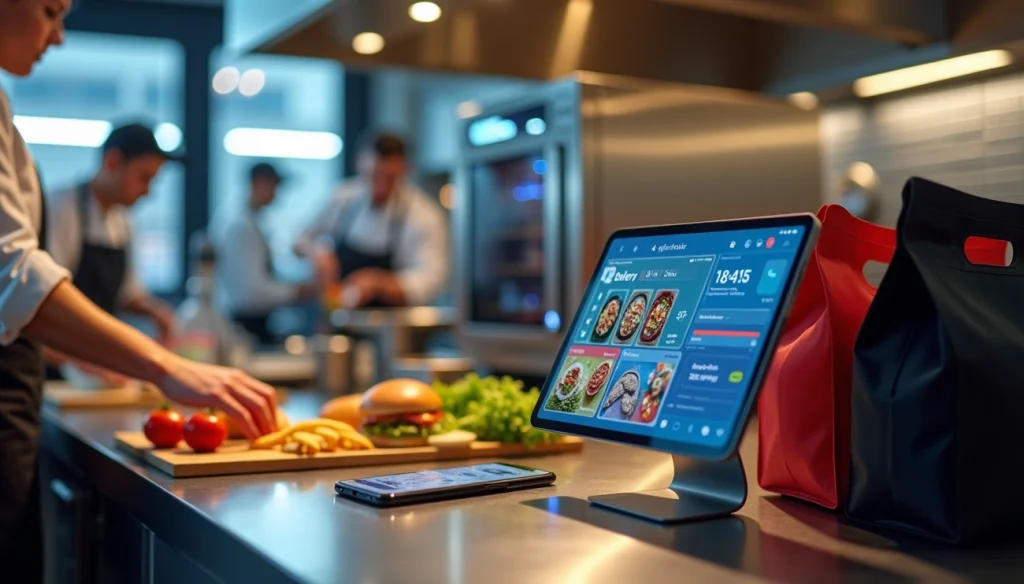
Online food delivery has exploded into a $173.57 billion market projected to grow at 10.7% annually through 2026. Technology in food service is driving this transformation and reshaping everything from how we browse menus to how quickly meals reach our doors. Artificial intelligence restaurant systems now handle orders through chatbots and automate kitchen prep with robots. They optimize delivery routes with up-to-the-minute precision. We’ve moved beyond phone calls and manual processes. Smart systems now predict what you’ll want before you order it. This piece explores how these advances work behind the scenes and what they mean for your next meal delivery.
What Technology Is Actually Changing in Food Service
Three distinct areas reveal where technology in food service creates the most visible effect: the moment you place an order, what happens inside restaurant kitchens, and how your meal travels to you.
Ordering Interfaces: From Phone Calls to AI Chatbots
Domino’s introduced Dom on Facebook Messenger in 2016, marking the original entry of chatbots into restaurants [1]. Ordering interfaces have evolved way beyond the reach and influence of simple automated responses since then. Modern artificial intelligence restaurant systems now use natural language processing to understand complex requests and handle order modifications. They process payments without human intervention [2].
Customer adoption tells the story. Among limited-service customers, 70% would use a smartphone app to place orders [3]. The numbers climb higher for delivery with 84% willing to order via restaurant websites and 8 in 10 using smartphone apps [3]. Voice ordering through smart speakers adds another layer. KFC deployed an AI voice-based robot capable of handling order changes and substitutions [4].
Self-order kiosks have proven their worth in accuracy and cost control. One pizza operator reported fewer than 1% of orders coming back as incorrect. Labor costs dropped to 11%-15% since cashiers became unnecessary [5]. McDonald’s pushed further with AI-powered voice ordering and dynamic menu displays that adjust based on immediate data [6].
Kitchen Automation and Smart Appliances
Behind kitchen doors, smart cooking systems now monitor and adjust cooking parameters without manual input [7]. These aren’t simple timers. Smart ovens from brands like Alto-Shaam and RATIONAL store recipes and track internal temperatures. They modify cooking cycles on their own [6]. A smart oven might adjust its temperature and humidity levels based on the specific dish being prepared. This removes guesswork from meal preparation [6].
Robotic assistants handle repetitive tasks with precision. Robotic arms flip burgers and prep ingredients. They plate dishes at speeds human cooks can’t match [6]. Smart refrigerators track inventory and notify staff when items run low or near expiration. This helps reduce food waste [7].
Kitchen Display Systems replaced the era of paper tickets and shouting across the line. These digital screens organize orders from dine-in, takeout and third-party delivery at once. They timestamp each order and track prep time. Late orders get prioritized during peak hours [6]. Providers like QSR Automations and Toast integrate these systems with POS and online ordering platforms [6].
Last-Mile Delivery Innovations
Delivery speeds accelerated by about 40% between 2020 and 2023 [8]. This jump came from multiple innovations working together. Micro-fulfillment centers brought inventory closer to customers and cut travel distances substantially [8]. The upfront cost runs $3 million to $5 million for a 10,000 to 12,000 square foot facility. The payback period hits two to three years [8].
Crowdsourcing models replaced single-carrier dependence. Two out of five retail executives switched volume away from FedEx or UPS to other providers in a 2024 survey [8]. Domino’s tested an AI delivery service in New Zealand using a three-foot-tall robotic unit. The unit drives on its own within a 12-mile range and carries up to ten pizzas [4].
Temperature-controlled delivery became non-negotiable for perishable items. Modern systems integrate with cold chain logistics and monitor temperature throughout the delivery experience to preserve product quality [8]. GPS tracking gives both businesses and customers exact location data and accurate arrival estimates [8].
The Smart Systems Deciding What Shows Up on Your Screen
Menu displays adapt to more than restaurant inventory. Artificial intelligence restaurant systems track individual behavior patterns, environmental conditions, and purchase history to personalize what appears on your screen.
How Apps Learn Your Eating Habits
Apps collect data from past orders, online reviews, and customer profiles to build taste priorities. IHOP deployed this approach and saw online sales jump 20% after implementing live personalized suggestions during the ordering process [8]. The system analyzed previous orders and customer feedback to predict what each person might want.
Wendy’s loyalty program reaches more than 3.5 million active users monthly and makes use of that information to send tailored deals based on typical ordering patterns [8]. Starbucks plans to install AI-powered menu screens that adjust suggestions based on individual priorities, time of day, and store location [8]. A morning customer might see espresso drinks highlighted. Afternoon visitors get cold brew recommendations.
Technology in food service now factors in store-level performance rather than relying on nationwide trends alone. Tillster’s system adapts recommendations to what sells well in specific locations and promotes regional favorites in one market while spotlighting seasonal items in another [9]. The system analyzes purchase history and ordering patterns to determine upsells and cross-sells live [9].
Weather and Events Influencing Menu Displays
Temperature affects what you order more than any other weather variable [3]. Research from Ohio State University examined over 3,200 customer comments from 32 fast casual restaurants paired with daily weather data, then surveyed more than 200 consumers in a variety of regions [3].
Sales of Belgium waffles, mixed grill, and French toast dropped when temperatures rose [3]. Items seen as high-calorie didn’t sell well during warmer weather, while low-calorie options kept steady sales [3]. Humidity mattered more than temperature in Florida. People still visited restaurants during hot weather if humidity stayed low, but high temperature combined with high humidity kept them home [3].
Dynamic pricing software now incorporates these patterns. One operator using Juicer’s algorithm allows a $4 spread on pulled pork plates and charges $15 during slow periods and $19 during peak times [10]. The system plans to factor in weather conditions like rain boosting grilled cheese and tomato soup orders, or football games driving pizza and wing sales [10].
Promotions Tailored to Your Order History
Predictive ordering systems analyze past patterns, customer priorities, time of day, weather conditions, and local events [11]. Restaurants using this technology report up to 20% increases in average order value through relevant upsells [11].
Dynamic pricing strategies now offer individualized pricing based on specific purchasing patterns and price sensitivity for loyalty members [12]. Those seeking discounts might order at 5 p.m. instead of 6 p.m. Convenience-focused customers pay premium prices on Friday nights [10].
AI-powered platforms customize orders for health-conscious diners and offer options to reduce sodium or suggest gluten-free alternatives aligned with their lifestyle [13]. The system remembers priorities, suggests favorite items, and anticipates special requests [11].
Behind the Scenes: Technology Making Kitchens Faster
Speed improvements in kitchens don’t happen by accident. Behind every faster meal delivery sits a network of automated equipment, forecasting algorithms and sensor systems working to eliminate bottlenecks before they occur.
Automated Food Prep Equipment
Automation handles repetitive kitchen tasks that previously required constant staff attention. Automated bun feeders toast bread without manual loading. Conveyors move food through preparation stations at programmed speeds [5]. Breading machines coat chicken wings and nuggets with consistent coverage, and touchless condiment dispensers portion sauces with precision [5].
These systems redirect staff to higher-value work rather than replacing them. Bun toasting runs on its own, so workers focus on grilling, plating and customer service [5]. Consistency improves across every plate. Kitchens stay cleaner because employees handle food less [5].
Demand Forecasting to Reduce Wait Times
Traditional forecasting methods produce disappointing results. Sales forecasts achieve only 60% accuracy on average, even though 72% of operators use tech-based tools [14]. Many still rely on last year’s sales data or manager intuition. The result? Over-ordered food, understaffed shifts and disappearing margins
[14].
Artificial intelligence restaurant forecasting changes this calculation. AI analyzes historical sales data, weather patterns and holiday needs to predict future requirements [14]. Crunchtime’s system breaks forecasts into 15-minute intervals and tells managers exactly when to prep more fries or start making salads [14]. The platform connects with POS systems and refreshes data every 15 minutes to provide accurate prep amounts [14].
Weather affects orders more than most operators realize. A rainy weekend or holiday rush shouldn’t catch teams unprepared, yet AI accounts for these patterns so managers show up with proper inventory and staffing [14]. Temperature drops on Friday evenings move orders from salads to hot entrees consistently, while rain reduces takeout by 18% but increases delivery 12% [15].
Accuracy matters for profitability. Chipotle reduced waste 30% while maintaining 99.8% menu availability using predictive ordering [15]. Multi-unit brands see portfolio-wide benefits that include 30-40% waste reduction and 15-25% labor optimization [15].
Equipment Sensors Preventing Breakdowns
Commercial kitchens lose $8,000-$12,000 per major appliance each year due to unplanned downtime, energy waste and reactive repair costs [16]. IoT-enabled monitoring reduces these losses by 35-45% while extending asset lifespans by 25-30% [16].
Sensors capture performance data that manual inspections check only once or twice daily [16]. Machine learning algorithms predict equipment failures with 91% accuracy 2-4 weeks in advance [17]. This foresight converts emergency closures into scheduled service calls during off-hours [17].
Temperature monitoring addresses food safety head-on. The FDA reports that 40% of foodborne illness outbreaks trace back to improper temperature control, and manual logging misses the 22 hours between checks when failures occur [16]. IoT sensors provide continuous monitoring with instant alerts when temperatures drift outside safe ranges [16].
A typical hotel restaurant that invests $5,000-$8,000 in IoT kitchen sensors recovers that investment within 6-10 months through reduced spoilage, lower repair costs, energy savings and labor efficiency [16].
How Your Food Gets to You Faster Than Ever
Delivery routes determine whether your meal arrives hot or sits in traffic getting cold. Artificial intelligence restaurant systems now calculate optimal paths using live data streams that manual dispatchers can’t process fast enough to act on.
AI Mapping the Quickest Delivery Routes
Route optimization in 2026 relies on live traffic data, predictive analytics and machine learning to create delivery paths that reduce costs and improve operations [8]. AI systems process live traffic conditions and vehicle statuses to anticipate delays before they happen [8]. These solutions adjust routes without dispatcher intervention when accidents or road closures occur [18].
AI routing reduces fuel costs by 20-30% within the first quarter of deployment [18]. AI-routed fleets achieve 95% or higher on-time delivery rates even during peak demand periods [18]. Optimized sequencing increases completed stops by 15-25% without adding vehicles or headcount [18].
The systems prioritize time-window stops first, then sequence remaining deliveries around them while distributing workload across active vehicles based on actual drive time [18]. AI incorporates delivery time priorities to reduce failed first-attempt rates [18].
Autonomous Delivery Vehicles and Drones
DoorDash’s Dot robot travels on bike lanes, roads, sidewalks and driveways at speeds up to 20 mph [19]. The Autonomous Delivery Platform functions as an AI dispatcher and matches each order with the optimal delivery method based on speed, cost, location and experience [19]. The platform makes these decisions in live time, whether that’s a human courier, a sidewalk robot or a drone [19].
Grubhub completed more than 100,000 robot deliveries across U.S. campuses, with The Ohio State University running the largest single-site program using over 120 robots [3]. Flytrex drones have flown over 200,000 meals to suburban households in the last three years [20]. Drone deliveries complete in less than 30 minutes with direct flight paths [21][22].
Multi-Order Batching to Improve Operations
Batching multiple orders into single trips optimizes delivery routes and minimizes average distance between stops and total miles driven [23]. Retailers save 20-30% per delivery through batching [23]. Businesses achieve 15-25% reduction in miles driven by batching more than four orders, cutting their carbon footprint
[23].
Temperature-Controlled Delivery Technology
Temperature-controlled express delivery keeps goods within strict thermal ranges, often between 2°C and 8°C, to preserve quality and prevent waste [24]. IoT sensors mounted on packages collect temperature, humidity and location data, transmitting it in live time [24]. Some delivery vehicles use moveable insulated walls that create compartments for goods with different temperature needs [10]. Smart refrigerating units direct cold air into specific sections without halting delivery [10].
What This Means for Restaurants and Customers
Technology in food service changes economics for both sides of the transaction. Restaurants control costs while customers receive faster and more accurate orders.
Lower Costs Leading to Better Prices
Food costs increased 21.8%, labor jumped 18.3%, and supplies climbed 16.7% compared to 2019 levels [25]. Restaurants turned to automation as operating expenses skyrocketed. A $100 monthly subscription for inventory and POS integration saves around $1,000 monthly through better stock management and automated reordering [25]. Robotics reduce labor costs by 30% to 70% and create substantial savings without sacrificing service quality [26].
Energy-efficient appliances and smart utility management cut water and electricity bills by a lot [27]. Automated scheduling prevents overstaffing during slow periods and reduces wait times while lowering labor expenses [27]. Self-ordering technology eliminates the need for at least one cashier position, with 70% of consumers preferring to order this way rather than from a cashier [25].
Fewer Order Mistakes and Faster Service
Order errors cost restaurants $30 per mistake on average [28]. One operator reported kitchen mistakes dropped 50% after implementing technology that lets customers input orders directly instead of relying on server transcription [29]. Digital ordering systems reduce errors by up to 30% through automated verification and clear kitchen communication [30].
The benefits extend beyond accuracy. Scaffidi’s Restaurant saw a 57% reduction in voids from out-of-stock items and a 35% decrease in customer refunds after switching to digital kitchen displays [31]. Self-service kiosks grew 43% from mid-2021 to June 2023 and reached nearly 350,000 installations around the world [26].
The Learning Curve for New Technology
Staff training presents challenges on the ground. Replacing each employee costs nearly $6,000 when factoring recruiting, onboarding, and lost productivity [32]. Restaurant teams resist new systems, especially when they already feel uncomfortable with existing technology [33]. Training needs hands-on guidance structured into workflow, with 90% retention when employees act on what they learned right away [34].
85% of restaurant leaders plan automation investments within the next year, while customers remain skeptical about technology replacing human interaction [31]. Three-quarters of consumers accept automation when it fills staffing gaps rather than displaces workers [31].
Conclusion
Technology in food service has moved beyond novelty into necessity. AI-powered ordering, smart kitchens, and optimized delivery routes work together to get your meals faster while reducing errors and costs for restaurants.
You’ll notice customized menu suggestions based on your habits, faster delivery times, and fewer mistakes in your orders. Restaurants benefit from reduced waste, lower labor costs, and better profit margins. These savings often translate to competitive pricing.
The transition requires training and adjustment, but adoption rates show that both operators and customers embrace these changes. Your next food delivery will arrive faster and more accurate than the last one, with technology working quietly behind every step.